BURAQ CFD
BURAQ CFD Consulting Aerospace: Precision Simulation for High-Stakes Engineering
BURAQ CFD Consulting Aerospace delivers precision simulation engineering for high-stakes aerospace projects. When every variable matters, BURAQ’s CFD expertise turns complex airflow challenges into reliable, actionable insights—empowering engineers to innovate confidently, reduce risk, and achieve breakthrough performance across demanding, high-stakes aerospace consulting and engineering applications.
BURAQ is a specialized CFD consulting firm serving the aerospace sector, offering high-fidelity fluid dynamics simulations that reduce prototype costs and accelerate certification timelines. Their expertise spans hypersonic aerodynamics, propulsion systems, thermal management, and regulatory-grade validation workflows.
What You Receive
A Buraq CFD project isn’t just a PDF at the end. You get the full package:
Simulation files. Mesh files, case files (.cas/.dat or equivalent), and solver settings, so you or your team can rerun, extend, or audit the work without starting over.
Boundary condition documentation. Every inlet condition, material property, and heat source assumption is recorded and justified, so the setup holds up in a design review or regulatory audit.
Turbulence model justification. A clear explanation of why we chose RANS, URANS, or LES for your flow regime, instead of whatever the software defaults to.
Mesh independence study. Results across multiple refinement levels, confirming the solution isn’t just an artifact of a coarse mesh.
Validation against real data. Wherever experimental, published, or manufacturer test data exists, we compare our predictions against it directly.
Design recommendations you can act on. A ranked list of changes and their expected impact, not just contour plots to interpret on your own.
This is the level of documentation your internal engineering team needs for sign-off, and what regulatory bodies expect for FAA, EASA, or MIL-SPEC submissions. It’s also what makes results defensible months or years later, when someone asks how you got there.
Introduction: Why CFD Consulting Aerospace Projects Can’t Afford to Get Wrong
CFD consulting for aerospace applications is one of the most technically demanding disciplines in modern engineering — and BURAQ has built its reputation entirely around getting it right. From the early design phase to flight certification, computational fluid dynamics shapes every critical decision: drag coefficients, thermal loads, fuel efficiency, and structural integrity all depend on simulation accuracy.
In aerospace, a miscalculation is not just costly — it can be mission-ending. That’s why engineering teams working on UAVs, satellite launchers, hypersonic vehicles, and commercial aircraft increasingly rely on specialist CFD consultants rather than in-house generalists.
BURAQ brings focused domain expertise, purpose-built workflows, and validated numerical methods to every project. The result is faster design cycles, fewer physical prototypes, and simulation results that hold up under regulatory scrutiny.
What Sets BURAQ Apart in CFD Aerospace Work
Deep Specialization in Aerospace Flow Regimes
Not all CFD providers handle the full range of aerospace flow conditions. BURAQ’s team works across the complete speed envelope:
- Subsonic and transonic flows — commercial and business aircraft aerodynamics
- Supersonic flows — missiles, launch vehicles, and inlet design
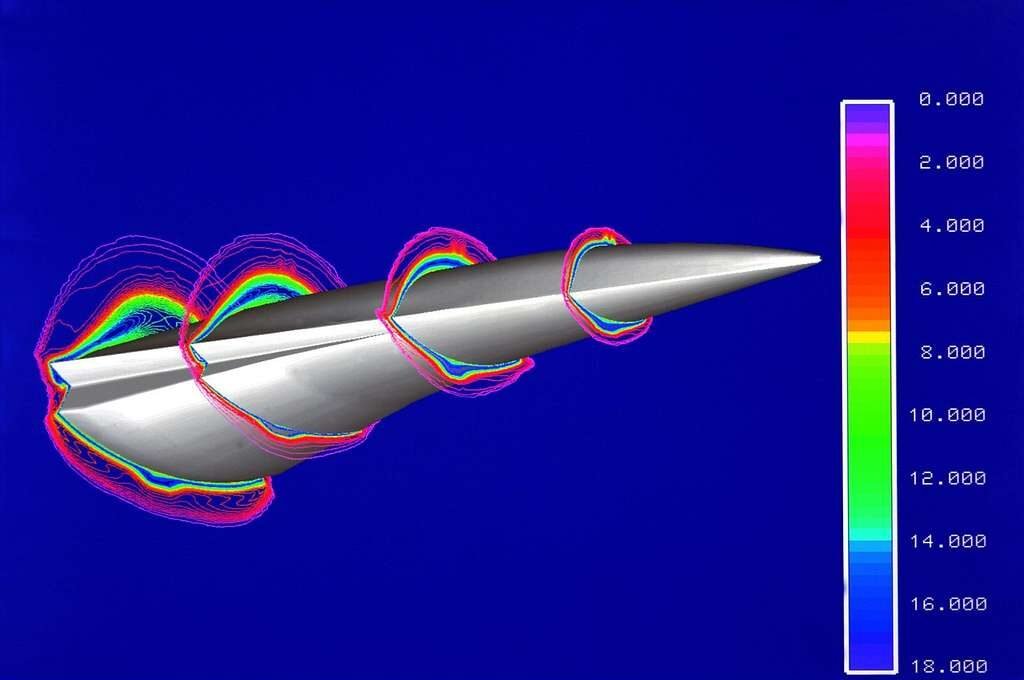
- Hypersonic flows (Mach 5+) — reentry vehicles, scramjet inlets, and thermal protection systems
- Low-Reynolds-number regimes — high-altitude UAVs and micro air vehicles
Each regime requires different turbulence models, mesh strategies, and solver settings. BURAQ engineers select and validate these choices for each specific application — not just apply default solver configurations.
Validated Numerical Methods
One of the most common failures in CFD work is delivering visually compelling results that don’t reflect physical reality. BURAQ’s approach is built around verification and validation (V&V):
- Code verification — confirming the solver solves the equations correctly
- Solution verification — mesh independence studies and numerical error quantification
- Validation — comparing simulation outputs to experimental wind tunnel data or published benchmark cases
This V&V discipline is what aerospace clients — especially those working toward EASA or FAA certification — need from a CFD partner.
Core CFD Aerospace Services Offered by BURAQ
External Aerodynamics
BURAQ performs full-aircraft and component-level external aerodynamic analysis. This includes:
- Lift, drag, and pitching moment prediction across the flight envelope
- Control surface effectiveness and hinge moment calculations
- Laminar-to-turbulent transition modeling
- Ice accretion and contamination effects on wing sections
For UAV developers, BURAQ provides optimized airfoil selection and fuselage-shaping analysis at the early concept stage — when CFD input yields the highest return on investment.
Propulsion and Internal Flow Analysis
Propulsion systems are among the most CFD-intensive components in any aircraft or launch vehicle. BURAQ’s CFD aerospace work in this area includes:
- Nozzle expansion and thrust vector analysis
- Combustion chamber flow and flame stability
- Intake/diffuser pressure recovery optimization
- Turbomachinery blade-passage simulations
Thermal Management and Heat Transfer
High-speed flight creates severe thermal environments. BURAQ applies conjugate heat transfer (CHT) methods to:
- Evaluate thermal protection system (TPS) performance on reentry vehicles
- Model aerodynamic heating on leading edges and control surfaces
- Simulate electronic cooling for avionics bays in both aircraft and spacecraft
Aeroelastic and Fluid-Structure Interaction (FSI)
Aerodynamic loads interact with structural deformation in ways that can lead to flutter, divergence, or fatigue failure. BURAQ’s FSI workflows couple CFD solvers with finite element analysis (FEA) codes to predict these effects before hardware is built.
Benefits of Partnering with a Specialist CFD Consultant
Pros
- Physical wind tunnel testing costs $10,000–$100,000+ per entry;
clients typically reduce total design validation costs by up to 40%
by replacing multiple physical test runs with high-fidelity CFD. - Faster design iteration — parametric studies that take weeks in the lab take hours in simulation.n
- Regulatory-grade documentation — structured V&V reports suitable for certification dossiers
- Access to specialized solvers — tools like OpenFOAM, ANSYS Fluent, STAR-CCM+, and SU2, configured by experts
- Objective third-party perspective — external consultants catch modeling assumptions that in-house teams may normalize.
Cons / Limitations to Be Aware Of
- CFD does not fully replace experimental testing for flight certification — it supplements it
- High-fidelity simulations (large meshes, unsteady flows) require significant HPC resources and lead to long run times.
- Results are only as good as the boundary conditions and geometry provided — garbage in, garbage out.
The key takeaway: BURAQ’s value is not just running simulations. It is knowing which simulation to run, how to set it up correctly, and how to interpret and communicate results.
How BURAQ Structures a Typical CFD Aerospace Engagement
Understanding the workflow helps engineering managers plan projects more effectively.
Step 1 — Requirements Definition: BURAQ begins with a technical scoping call to clarify the flow regime. What geometry fidelity is available (CAD, STL, point cloud)? What outputs are needed (forces, pressures, temperatures)? What is the decision being made with this data?
Step 2 — Geometry Cleanup and Meshing: CAD geometry almost always requires simplification and defeaturing for CFD. BURAQ handles surface cleanup and generates high-quality structured or unstructured meshes appropriate for the flow conditions.
Step 3 — Solver Setup and Boundary Conditions: Turbulence model selection, boundary condition specification, and convergence criteria are defined with an explicit rationale — not left to defaults.
Step 4 — Simulation Execution: Simulations run on BURAQ’s HPC infrastructure or client-provided clusters. Steady-state RANS simulations may take hours; large-scale LES or transient simulations may take days.
Step 5 — Post-Processing and Reporting: Results are delivered as interactive 3D visualizations, publication-quality plots, and a structured technical report with uncertainty quantification and recommendations.
Step 6 — Design Iteration Support: BURAQ supports follow-on geometry modifications and parametric sweeps, so the simulation investment compounds across multiple design variants.
Real-World Application: UAV Aerodynamic Optimization
Consider a mid-size fixed-wing UAV developer preparing for airworthiness certification. Their in-house team had limited CFD experience and faced a 6-month timeline to validate aerodynamic performance over a 20–120-knot speed range.
BURAQ conducted a structured CFD aerospace analysis campaign:
- Built a parametric mesh for 12 angle-of-attack conditions
- Ran RANS simulations using the SST k-ω turbulence model, validated against NACA benchmark data
- Identified a premature flow separation on the outboard wing at high angles of attack
- Proposed and simulated a modified leading-edge geometry that eliminated the separation
The result: the UAV passed initial airworthiness review on the first submission, saving an estimated 3 months of re-design time and one full wind tunnel test entry.
This is exactly the kind of outcome that specialist CFD consulting makes possible — not just running numbers, but solving an engineering problem.
Expert Insight: What Makes CFD Results Trustworthy in Aerospace?
Aerospace engineers in the aerospace simulation community consistently point to three factors that separate credible CFD work from superficial analysis:
1. Mesh quality metrics matter more than mesh size. A coarse, well-structured mesh with proper boundary-layer resolution routinely outperforms a dense, poorly generated mesh.
2. Turbulence model selection must match the physics. The Spalart-Allmaras model is efficient for attached flows; SST k-ω is better for flows with adverse pressure gradients; LES is required when unsteady wake structures are physically important.
3. Convergence is not the same as accuracy. A simulation can converge on a physically incorrect solution if the boundary conditions are misspecified. BURAQ’s review process includes physical sanity checks at every stage.
These principles are embedded in BURAQ’s standard operating procedures, ensuring that every CFD consulting engagement in aerospace produces results that engineering teams can genuinely rely on.
Conclusion
For aerospace programs where simulation accuracy directly influences design decisions, safety margins, and certification outcomes, choosing the right CFD partner is a strategic call. BURAQ’s focused expertise in CFD consulting for aerospace applications — from subsonic UAVs to hypersonic reentry vehicles — provides engineering teams with the technical depth, validated workflows, and clear communication that complex programs demand.
Whether you are optimizing a propulsion inlet, characterizing wing stall behavior, or modeling thermal loads on a spacecraft, BURAQ brings the rigor that CFD aerospace work requires. The investment in specialist simulation pays for itself many times over in reduced testing costs, faster schedules, and higher first-pass design success rates.
FAQ Schema Section
Q1: What is CFD consulting in aerospace, and why is it important? CFD (Computational Fluid Dynamics) consulting in aerospace involves using numerical simulation to model how air, exhaust gases, or other fluids interact with aircraft, spacecraft, or propulsion components. It is critical because it enables engineers to predict aerodynamic performance, thermal loads, and flow stability before physical hardware is built — reducing cost and risk across the design cycle.
Q2: What types of aerospace projects does BURAQ support with CFD analysis? BURAQ supports a wide range of aerospace projects, including fixed-wing UAVs, commercial and business aircraft, launch vehicles, hypersonic vehicles, reentry capsules, and propulsion systems. Their work spans external aerodynamics, internal flow, thermal management, and fluid-structure interaction.
Q3: How accurate is CFD compared to wind tunnel testing for aerospace applications? Modern high-fidelity CFD, when properly validated, achieves force and moment predictions within 1–5% of experimental data for well-defined flow conditions. For complex cases involving transition, separation, or unsteady effects, wind tunnel data is still required for final validation — but CFD dramatically reduces the number of test points needed.
Q4: What CFD software tools does BURAQ use for aerospace simulations? BURAQ works with industry-standard solvers,s including ANSYS Fluent, STAR-CCM+, OpenFOAM, and SU2, selecting the appropriate tool based on the flow physics, geometry complexity, and client infrastructure requirements. All solver configurations are documented for reproducibility.
Q5: How long does a typical CFD aerospace consulting project take? Project duration depends on scope and complexity. A focused aerodynamic analysis for a UAV component may be completed in 2–4 weeks. A comprehensive multi-condition campaign for a launch vehicle or hypersonic vehicle, including V&V documentation, typically requires 6–12 weeks. BURAQ provides detailed project schedules during the scoping phase.