BURAQ CFD Software Tools: The Right Solver for Every Engineering Problem
Selecting the right CFD software tools is one of the most consequential decisions in any simulation project — the wrong choice leads to inaccurate results, wasted compute time, and failed design decisions. BURAQ works across the full spectrum of professional solvers, including ANSYS Fluent, STAR-CCM+, OpenFOAM, and SU2, matching each tool to the project’s specific physics, scale, and budget.
Introduction: Why CFD Software Tools Selection Defines Project Success
Choosing the right CFD software tools is not a procurement decision — it is an engineering one. The solver you use determines which turbulence models are available, how the mesh interfaces with the physics, what multi-physics coupling is possible, and how reliably results can be validated against experimental data.
BURAQ’s simulation team works across every major commercial and open-source platform in active use today. That platform-agnostic approach is deliberate. No single tool is best for every problem, and locking every project into one solver — regardless of fit — is one of the most common sources of poor CFD outcomes.
This guide covers the core CFD software tools BURAQ deploys, how each is selected, and what engineering teams should understand when evaluating solvers for their own projects.
The CFD Software Landscape: Commercial vs. Open-Source
Before examining individual tools, it helps to understand the two broad categories every engineering team navigates.
Commercial CFD Software Tools
Commercial solvers come with:
- Dedicated technical support from the vendor
- Polished graphical user interfaces (GUIs) for pre- and post-processing
- Validated solver frameworks with published accuracy benchmarks
- Licensing costs — typically $20,000–$80,000/year per seat for full packages
They are the standard choice for regulated industries (aerospace, automotive, nuclear) where software traceability and vendor qualification are required for certification.
Open-Source CFD Software Tools
Open-source platforms — primarily OpenFOAM and SU2 — offer:
- Zero licensing cost (critical for HPC scaling across hundreds of cores)
- Full source code access for custom solver development
- Large community support bases with extensive documentation
- Higher setup expertise requirements compared to GUI-driven commercial tools
For research institutions, cost-sensitive industrial clients, and projects requiring custom physics models, open-source tools deliver professional-grade results when operated by experienced engineers.
BURAQ uses both categories — the deciding factors are physics requirements, project scale, client infrastructure, and regulatory context.
BURAQ’s Core CFD Software Tools: A Platform-by-Platform Breakdown
ANSYS Fluent
ANSYS Fluent is the most widely deployed commercial CFD solver globally, and for good reason. Its strengths include:
- Mature, extensively validated turbulence model library (k-ε, k-ω SST, Reynolds Stress Model, transition models)
- Robust pressure-based and density-based solvers for incompressible through supersonic flow
- Integrated combustion, species transport, and radiation models
- Direct coupling with ANSYS Mechanical for fluid-structure interaction
BURAQ uses Fluent primarily for:
- Industrial internal flow analysis (HVAC, process equipment, heat exchangers)
- Subsonic and transonic external aerodynamics
- Conjugate heat transfer in electronics and propulsion components
Best for: Clients requiring vendor-backed software traceability, or projects where GUI-driven workflows reduce setup time.
ANSYS CFX
CFX is ANSYS’s turbomachinery-optimized solver. Unlike Fluent’s finite-volume approach, CFX uses a coupled algebraic multigrid solver that converges robustly for rotating-machinery problems.
Key strengths:
- Industry benchmark accuracy for compressor and turbine blade-passage simulations
- Native stage interface (mixing plane) and transient rotor-stator capabilities
- Tightly integrated with ANSYS BladeModeler and TurboGrid for end-to-end turbomachinery workflows
BURAQ deploys CFX specifically for axial and centrifugal compressors, turbines, and pump impeller analyses — where its rotating frame capabilities outperform general-purpose solvers.
Siemens STAR-CCM+
STAR-CCM+ is the strongest commercial option for complex, multi-physics, industrial-scale simulations. Its differentiating capabilities include:
- Polyhedral meshing: automatically generates high-quality meshes on complex CAD geometries faster than structured approaches
- Overset (Chimera) mesh: essential for moving body problems — store separation, control surface deflection, landing gear deployment
- Integrated co-simulation with structural solvers for FSI
- Design Exploration module for automated parametric optimization studies
BURAQ uses STAR-CCM+ for:
- Automotive aerodynamics and underhood thermal management
- Marine and offshore flow studies
- Complex multi-body aerospace simulations requiring an overset mesh
- Automated design optimization campaigns
Best for: Projects with highly complex geometry, multi-physics requirements, or parametric design sweeps.
OpenFOAM
OpenFOAM is the dominant open-source CFD platform and one of the most powerful tools in BURAQ’s CFD software list. It runs natively on Linux HPC clusters without per-core licensing fees — a major advantage for large-scale simulations.
BURAQ’s OpenFOAM capabilities include:
- Custom solver development for non-standard physics (non-Newtonian fluids, novel combustion models, electrokinetic flows)
- Large Eddy Simulation (LES) and Detached Eddy Simulation (DES) at scale
- Automated mesh generation using snappyHexMesh for complex external geometries
- Full integration with ParaView for post-processing and visualization
A key insight from BURAQ’s experience: OpenFOAM’s flexibility is also its complexity. An engineer who knows how to configure OpenFOAM correctly produces results that are indistinguishable from those of premium commercial solvers. This engineer can’t produce plausible-looking but physically incorrect simulations. Expertise matters more than the tool itself.
Best for: Large parametric studies, research-grade LES, custom physics, and cost-sensitive industrial clients.
SU2
SU2 is an open-source multiphysics solver developed at Stanford University, with particular strengths in:
- Aerodynamic shape optimization using adjoint methods
- High-speed compressible flow (transonic through hypersonic)
- Structural and heat equation solvers alongside the flow solver
BURAQ uses SU2 specifically for aerodynamic optimization workflows — gradient-based shape optimization that automatically modifies wing profiles, nozzle contours, or inlet geometries to meet performance targets. This is a capability that most commercial tools charge significant add-on fees to access.
Best for: Adjoint-based aerodynamic optimization, academic/research collaboration, compressible flow studies.
Pointwise and ANSYS Meshing
No discussion of CFD software tools is complete without addressing mesh generation. Even the best solver produces poor results on a bad mesh.
BURAQ uses:
- Pointwise for structured and hybrid meshing on aerospace geometries requiring precise boundary layer control
- ANSYS Meshing for integrated workflows within the ANSYS ecosystem
- snappyHexMesh (OpenFOAM’s native mesher) for automated hex-dominant meshing on complex external geometries
- ICEM CFD for legacy structured mesh projects in turbomachinery
Mesh generation typically accounts for 20–35% of the total simulation project time. BURAQ’s investment in purpose-built meshing tools — rather than relying on solver-native auto-meshing — directly contributes to the accuracy of results.
Pros and Cons: Key Insights on CFD Software Tool Selection
ANSYS Fluent
Pros: Widest validation database; strong GUI; excellent support. Cons: High licensing cost; less efficient on extreme HPC scaling
STAR-CCM+
Pros: Best-in-class for complex geometry and multi-physics; polyhedral meshing.g Cons: Expensive; steep learning curve for advanced features
OpenFOAM
Pros: Free; highly scalable; fully customizable.le Cons: No vendor support; requires Linux expertise; GUI tools are limited
SU2
Pros: Best adjoint optimization capability; free; research-grade accuracy.acy Cons: Narrower physics library than commercial tools; smaller user community
CFX
Pros: Unmatched for turbomachinery accuracy; robust convergence.ence Cons: Less general-purpose than Fluent; limited to rotating machinery applications
How BURAQ Selects CFD Software Tools for Each Project
The selection process follows a structured decision framework:
Step 1 — Define the governing physics. Is the flow compressible or incompressible? Steady or unsteady? Single-phase or multi-phase? Does it involve chemical reactions, structural coupling, or moving bodies?
Step 2 — Assess geometry comp.lexity Simple internal flow → Fluent or CFX. Complex multi-body external flow → STAR-CCM+. Large external aerodynamics on HPC → OpenFOAM.
Step 3 — Check regulatory requirements.Requirements. If the result feeds a certification dossier, vendor-backed commercial software with traceable version control is typically required.
Step 4 — Consider scale and compute budget. For simulations requiring 200+ cores, OpenFOAM’s zero-per-core licensing makes it economically dominant over any commercial alternative.
Step 5 — Match to available validated workflows.s BURAQ’s team maintains validated case setups for benchmark problems across all major platforms. New projects are initialized from these validated baselines — not built from scratch, thereby reducing errors and accelerating delivery.
Real-World Example: Selecting the Right Tool for a Hypersonic Inlet Study
A defense contractor approached BURAQ for a scramjet inlet performance study at Mach 6. The requirements are accurate prediction of shock-boundary-layer interaction, wall heat flux distribution, and inlet pressure recovery across multiple angles of attack.
BURAQ’s tool selection:
- Primary solver: OpenFOAM with a density-based compressible solver (rhoCentralFoam), configured for high-speed flows
- Turbulence model: SST k-ω with compressibility corrections
- Mesh: Structured hex mesh generated in Pointwise with y+ < 1 at all wall surfaces
- Validation: Results compared against published NASA experimental data for Mach 6 flat plate and inlet geometries
The decision to use OpenFOAM over ANSYS Fluent was driven by HPC scale — 350 cores were needed for the parametric sweep, making commercial licensing costs prohibitive. Final results matched experimental wall pressure distributions within 4%, well within the project’s accuracy requirement.
Conclusion
The right CFD software tools are not always the most expensive ones — they are the ones that match the physics, scale, geometry, and regulatory context of your specific project. BURAQ’s platform-agnostic approach, combined with deep expertise across the full CFD software list, means every engagement starts with the best tool for the job, not the default tool in the office.
Whether your project calls for ANSYS Fluent’s validated industrial workflows, STAR-CCM+’s geometry-handling power, or OpenFOAM’s HPC-scale flexibility, the underlying principle is the same: simulation accuracy is a function of engineering judgment, not software brand.
FAQ Schema Section
Q1: What are the most widely used CFD software tools in professional engineering? The most widely used professional CFD software tools include ANSYS Fluent, Siemens STAR-CCM+, ANSYS CFX, OpenFOAM, and SU2. Commercial tools like Fluent and STAR-CCM+ dominate regulated industries due to vendor support and certification traceability. At the same time, OpenFOAM is the leading open-source option for large-scale HPC simulations and custom physics development.
Q2: What is the difference between ANSYS Fluent and STAR-CCM+ as CFD software tools? ANSYS Fluent has a broader validation database and is the most established tool for industrial internal and external flow problems. STAR-CCM+ has superior geometry handling through polyhedral meshing and stronger multi-physics coupling capabilities, making it preferred for complex industrial geometries and automated parametric optimization. Both are professional-grade tools; the choice depends on project geometry complexity and physics requirements.
Q3: Is OpenFOAM accurate enough for professional aerospace CFD work? Yes — when configured by experienced engineers, OpenFOAM produces results equivalent to commercial solvers for most aerospace applications. It is widely used in aerospace research institutions and commercial consulting firms. Its primary advantages are zero per-core licensing cost and full solver customization; its primary limitation is the lack of vendor technical support, which makes expert configuration essential.
Q4: What CFD software tools does BURAQ use for turbomachinery analysis? BURAQ uses ANSYS CFX as the primary solver for turbomachinery applications, including axial compressors, centrifugal pumps, and turbine blade-passage analysis. CFX’s coupled algebraic multigrid solver and native rotating-frame capabilities — including mixing-plane and transient rotor-stator interfaces — deliver benchmark-level accuracy for rotating machinery problems.
Q5: How do I know which CFD software tool is right for my project? The right tool depends on four factors: the governing physics (compressible vs. incompressible, single vs. multi-phase, steady vs. unsteady), geometry complexity, regulatory requirements (certification traceability may require commercial software), and simulation scale (HPC core count affects licensing economics). BURAQ’s project scoping process addresses all four factors before any solver is selected.
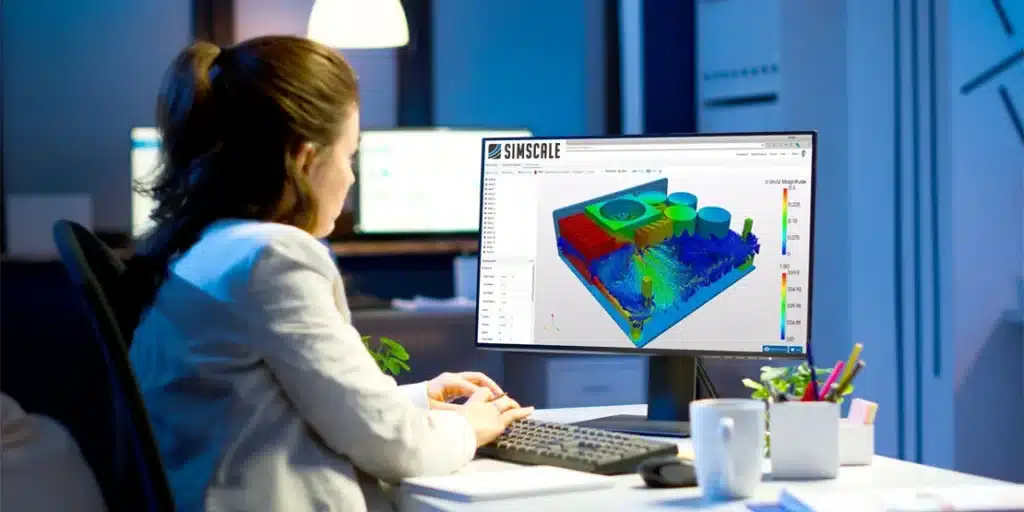
BURAQ CFD software tools comparison including ANSYS Fluent and OpenFOAMCFD software list showing solver selection for aerospace and industrial applicationsEngineer using BURAQ CFD software tools for turbulence simulation post-processingSTAR-CCM+ and OpenFOAM CFD software tools mesh visualization on HPC cluster